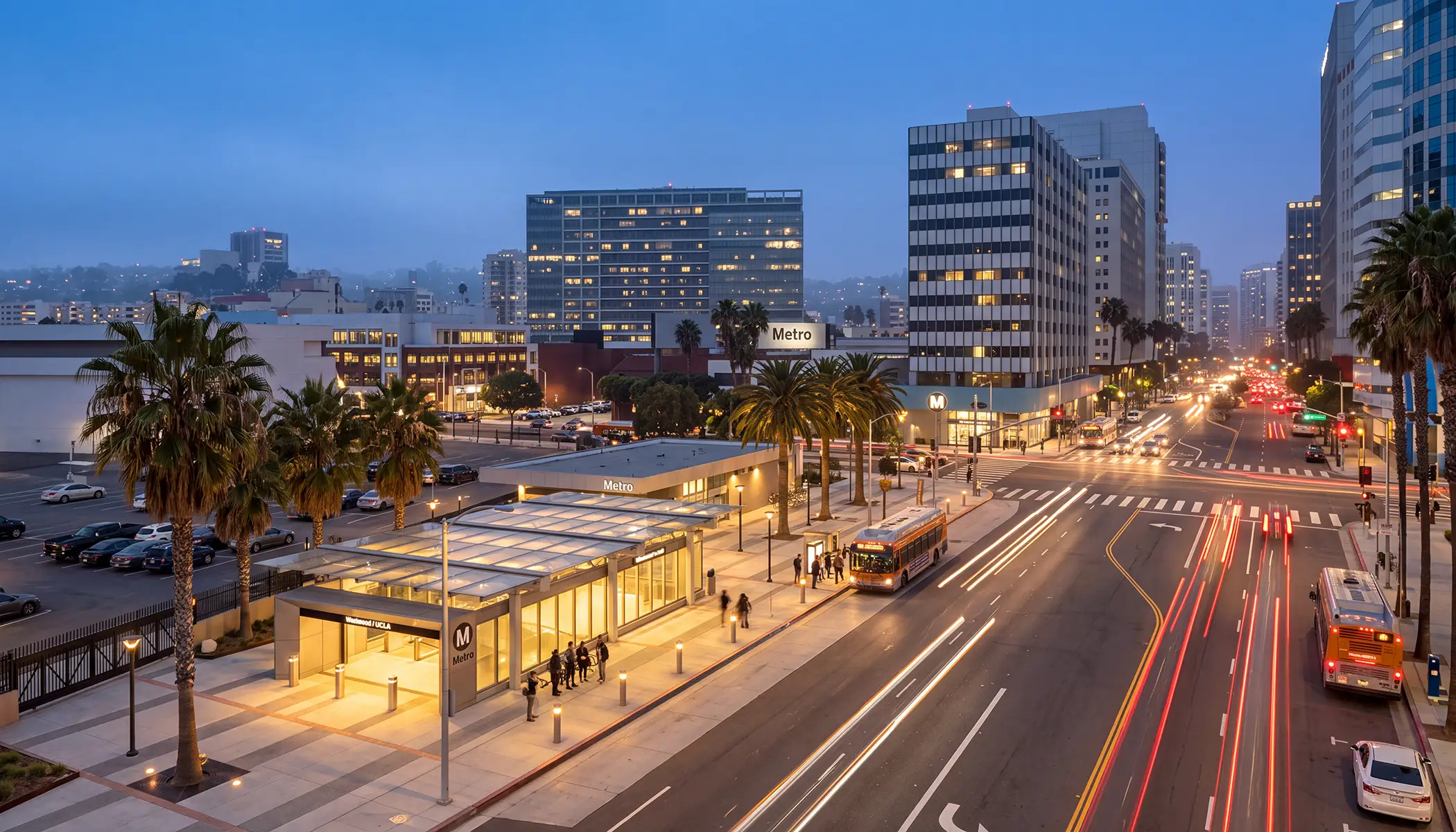

The first section of the Purple Line D Line Extension opened on May 8, 2026. Three new stations now connect Wilshire/Western to Wilshire/La Cienega. For anyone tracking Purple Line Westwood real estate implications, that milestone was significant. But the stations that matter most to the 90024 zip code haven’t opened yet. The Century City station is projected for spring 2027. The Westwood/UCLA and Westwood/VA stations are targeted for fall 2027. That puts them ahead of the 2028 Los Angeles Olympics, where UCLA will serve as the athlete village.
The question every Westwood homeowner and prospective buyer is asking is straightforward: what does this mean for property values? The answer requires separating what we actually know from what people assume. It also means looking at what comparable transit projects in other cities have done to surrounding real estate.
Where the D Line Extension Stands Right Now
The Purple Line Extension is a 9.0-mile, three-section subway project. It extends the existing D Line (formerly Purple Line) from its current terminus at Wilshire/Western to the VA campus west of the 405 freeway. It’s the largest transit infrastructure project in Los Angeles history and one of the largest in the country. LA Metro’s project page tracks the latest construction updates.
Section 1 (Wilshire/Western to Wilshire/La Cienega) opened May 8, 2026. The three stations at Wilshire/La Brea, Wilshire/Fairfax, and Wilshire/La Cienega are operational, and early ridership has been strong. This section cost approximately $2.8 billion and took roughly seven years to build.
Section 2 (Wilshire/La Cienega to Century City/Constellation) is approximately 83% complete. It carries an estimated cost of $2.9 billion. The tunneling is finished. Station construction and system installation are underway. Metro’s current projection is spring 2027 for revenue service. This section adds one station at Wilshire/Rodeo in Beverly Hills. The other is at Century City/Constellation near the Westfield mall.
Section 3 (Century City to Westwood/VA) is approximately 75% complete. It has an estimated budget of $4.4 billion. This is the section that directly serves Westwood. It includes two stations: Westwood/UCLA at Wilshire and Gayley, and Westwood/VA at the VA campus near Bonsall Avenue. Metro is targeting fall 2027 for completion. The elevated cost reflects the challenging tunneling under the Santa Monica Mountains. The Westwood stations will sit roughly 100 feet below street level.
When all three sections are operational, a resident at the Westwood/UCLA station will be able to reach Downtown LA in approximately 25 minutes. That’s a commute that currently takes 45 minutes to over an hour by car during peak hours.
The Construction Impact: What Westwood Has Already Absorbed
Before talking about the upside, it’s worth acknowledging what Westwood has endured. The construction disruption along Wilshire Boulevard has been significant and sustained. Lane closures, detours, noise, and staging areas have been a daily reality for years. Restricted access to businesses and residential buildings added to the burden.
The Wilshire Corridor condo market has absorbed the worst of this. Buildings along Wilshire between Veteran and Gayley have dealt with construction activity directly outside their lobbies. Street-level retail in the Village has lost foot traffic. Some businesses have closed, and others have operated at reduced capacity.
Sellers during the construction period have sometimes discounted relative to comparable properties in unaffected areas. Buyers who purchased during peak construction, particularly in 2023 through 2025, may have acquired properties at a discount. That construction-era pricing could look very attractive once the stations open.
The point is that the construction penalty is already priced into much of what has traded in Westwood over the last three years. What lies ahead is the reversal: the accessibility premium that arrives when the disruption ends and the stations open.
What Transit Does to Property Values: The Data from Other Cities
The most useful framework for understanding how the Purple Line will affect Westwood real estate isn’t speculation. It’s looking at what happened near comparable transit stations in comparable markets.
The academic literature on transit-oriented development and property values is extensive. A meta-analysis across multiple US and international markets consistently shows that proximity to rail transit stations increases residential property values. The effect is strongest for heavy rail and subway systems, as opposed to light rail or bus rapid transit.
The range varies by market, but the pattern is consistent. Properties within a quarter-mile of a new subway station typically see a 5% to 15% price premium. This is relative to comparable properties farther away, controlling for other factors. The premium is higher in markets with severe traffic congestion, which describes Los Angeles. It’s also higher for stations connecting to major employment and cultural centers. The D Line runs from Downtown LA through Koreatown, Miracle Mile, Beverly Hills, Century City, and Westwood.
The Expo Line: A Local Comparison
The Expo Line in Los Angeles provides a local comparison. When it opened to Santa Monica in 2016, properties within a half-mile of stations saw measurable appreciation. The effect was stronger in neighborhoods where car commuting dominated. Areas with the most significant time savings from transit benefited most.
The D Line Extension is a subway, not light rail. Subway systems typically generate stronger property premiums than surface-level rail. They run more frequently, offer faster travel times, and don’t compete with street traffic. The Westwood stations will connect to every major employment corridor along Wilshire. That’s the kind of connectivity that changes how people evaluate location.
What This Means for Purple Line Westwood Real Estate Specifically
The impact won’t be uniform across all of Westwood. Property type, proximity to the stations, and current price point all affect how much upside to expect.
The Wilshire Corridor will likely see the most direct impact. These are the condo buildings that line Wilshire Boulevard within walking distance of the Westwood/UCLA station. Residents of the Carlyle, the Wilshire House, the Comstock, and similar full-service buildings will have subway access within a short walk. For a buyer comparing a Wilshire Corridor condo to a comparable building in Brentwood or Santa Monica, transit access becomes a new differentiator. I’ve written a detailed guide to the Wilshire Corridor buildings that covers each property’s positioning.
Beyond the Corridor: Single-Family and Estate Properties
Single-family homes in the Westwood flats will benefit from improved connectivity, but the effect will be more moderate. These homeowners aren’t typically commuting by subway. Home values here are driven more by lot size, school district, and neighborhood character than by transit access. The benefit is indirect. The subway makes the broader Westwood area more desirable and supports commercial vitality in the Village. It also makes it easier for students and younger professionals in the household to commute without a car.
Properties in Westwood Hills and Little Holmby are the farthest from the stations. They will see the least direct transit premium. These neighborhoods sell on privacy, lot size, views, and prestige. Transit access is a secondary consideration for buyers in the $5 million to $15 million range. That said, any factor that makes Westwood more attractive lifts all boats. Improved access for household staff, service providers, and visitors has practical value even for high-end homeowners.
The student and rental market near UCLA may see the most immediate demand impact. The Westwood/UCLA station puts students, faculty, and staff within a direct subway ride of Koreatown and Downtown. Eventually, transfers will connect to much of the Metro system. That connectivity reduces car dependency for a population that often doesn’t want to own a car. It makes Westwood housing more attractive relative to other near-campus options.
The Olympics Factor: 2028 Timing and the International Audience
The timing of the D Line Extension is not incidental. Metro fast-tracked the project to ensure the Westwood stations are open before the 2028 Los Angeles Olympics, where UCLA will serve as the athlete village and a primary venue cluster.
During the Games, Westwood will be one of the most visible neighborhoods in the world. The subway connection to Downtown (where the LA Coliseum, Crypto.com Arena, and other venues are located) will be the primary transportation link for athletes, officials, media, and spectators traveling to and from the UCLA campus.
This creates a marketing effect that’s difficult to quantify but real. International buyers, investors, and relocating families who watch the Olympics will see Westwood differently. They’ll see a connected, accessible, world-class neighborhood, not the traffic-bound enclave it’s been perceived as for decades. For Purple Line Westwood real estate, the Olympics exposure amplifies buyer interest at exactly the moment when the transit infrastructure is new.
The Timeline for Price Impact
Transit premiums don’t arrive all at once. The research shows a fairly consistent pattern across markets.
The announcement premium occurs when the project is approved and funded. For the Purple Line, this largely materialized between 2017 and 2019. The full alignment was confirmed and construction began. Buyers who purchased during that period with transit in mind have already captured some of the upside.
The construction discount occurs during active construction. Disruption depresses values relative to what they’d be without the noise, closures, and visual blight. For Westwood, this period runs roughly from 2020 through 2027. Properties that traded during this window, particularly on Wilshire Boulevard, may have traded below their post-construction potential.
The opening premium materializes in the 12 to 24 months after station opening, as the market adjusts to the reality of the service. This is when the most measurable appreciation occurs. For the Westwood/UCLA station, this window will be fall 2027 through late 2029.
The maturation premium builds over the following three to five years as ridership stabilizes, transit-oriented development fills in, and the station area establishes its character. Commercial investment near the stations, improved pedestrian infrastructure, and increased foot traffic all contribute to this longer-term value accretion.
If you’re a seller considering timing, the sweet spot is likely 18 to 36 months after the Westwood stations open. That’s when the premium is established but before the market fully prices in the new normal. If you’re a buyer, the current construction-period window represents the last opportunity to purchase before the opening premium arrives.
What Buyers and Sellers Should Do Now
For sellers considering listing in 2026 or early 2027, understand that you’re selling before the station opens. Your pricing needs to reflect that. You can reference the coming transit access as a selling point. However, buyers aren’t going to pay the full opening premium for a station that isn’t operational yet. If your timeline is flexible, the hold-versus-sell calculation should factor in the expected appreciation.
For buyers looking at Westwood now, you are purchasing at a unique moment. Construction disruption is depressing the experience of the neighborhood, but the transit benefit is imminent. This is arguably the most favorable entry point for transit-aware buyers. The disruption discount is still present, and the opening is close enough to model with confidence.
For investors evaluating Westwood rental properties, the subway will expand the tenant pool significantly. It makes Westwood accessible to commuters who work along the entire Wilshire corridor. A renter who works in Koreatown or Miracle Mile currently wouldn’t consider Westwood because of the car commute. With a 15-minute subway ride, that calculation changes. This demand expansion supports both occupancy and rent growth.
For anyone making a long-term hold decision, the Purple Line Extension is permanent infrastructure. It doesn’t depreciate, it doesn’t go out of fashion, and it will only become more valuable as the Metro system expands. Properties near the stations will carry a transit premium indefinitely. Subway-adjacent properties in New York, London, and Tokyo command premiums that have compounded for decades.
Frequently Asked Questions About the Purple Line and Westwood Real Estate
When will the Purple Line reach Westwood?
The Westwood/UCLA station at Wilshire and Gayley and the Westwood/VA station at the VA campus are both targeted to open in fall 2027. Section 1 of the D Line Extension (Wilshire/Western to Wilshire/La Cienega) opened May 8, 2026, and Section 2 to Century City is projected for spring 2027. Metro has committed to opening all sections before the 2028 Los Angeles Olympics.
How will the Purple Line affect Westwood property values?
Research on comparable transit projects shows that properties within a quarter-mile of new subway stations typically see a 5% to 15% price premium. The effect is strongest in high-congestion markets with connections to major employment centers, both of which describe the D Line Extension. Wilshire Corridor condos closest to the Westwood/UCLA station are expected to see the most direct impact, while single-family homes farther from the stations will benefit more indirectly.
Is now a good time to buy in Westwood because of the Purple Line?
The current window offers a combination of construction-period disruption discounts and proximity to station openings that creates a potentially favorable entry point. Buyers purchasing now are acquiring before the opening premium that typically materializes in the 12 to 24 months following station service. However, this should be one factor among many in a purchase decision, not the sole driver.
How long will it take to get from Westwood to Downtown LA on the Purple Line?
Approximately 25 minutes from the Westwood/UCLA station to Downtown LA, compared to 45 minutes to over an hour by car during peak commute hours. The D Line will run through Beverly Hills and Century City, connecting to the existing Metro system at Wilshire/Western with service to Koreatown, Downtown, and transfer points to other lines.
Will the Purple Line affect Westwood rents?
Transit access typically supports rent growth by expanding the pool of potential tenants. The D Line will make Westwood accessible to commuters working along the entire Wilshire corridor and Downtown, many of whom currently wouldn’t consider Westwood due to car commute times. This demand expansion, combined with Westwood’s existing appeal for UCLA students and professionals, is expected to support both occupancy rates and rental pricing.
What’s happening with the construction disruption on Wilshire Boulevard?
Section 3 construction through Westwood is approximately 75% complete. The most intensive tunneling work is finished, and remaining construction is focused on station build-out and system installation. As sections complete, surface disruption will decrease. Full restoration of Wilshire Boulevard through Westwood is expected to follow the fall 2027 station openings, with streetscape improvements that should exceed pre-construction conditions.
How does the Olympics affect the Purple Line timeline and Westwood real estate?
The 2028 Los Angeles Olympics, with UCLA as the athlete village, was a key driver in Metro’s commitment to completing all three sections before the Games. The international visibility of Westwood during the Olympics, combined with a functioning subway connection to other venue clusters, is expected to increase global awareness of the neighborhood and attract international buyer and investor interest.
If you’re weighing how the D Line Extension affects your property, your purchase timeline, or your investment strategy, I’d welcome the chance to talk. Purple Line Westwood real estate is entering a new phase. The construction disruption is winding down. The access premium is approaching. The window to act on that transition is narrowing.
If you’re weighing how the D Line Extension affects your property, your purchase timeline, or your investment strategy in Westwood or the Wilshire Corridor, I’d welcome the chance to walk through the data specific to your situation. The construction disruption is winding down. The access premium is approaching. The window to act on that transition is narrowing.
You can reach me at (310) 299-7655 or pshilian@compass.com.
Disclaimer: This article is provided for informational and educational purposes only and does not constitute real estate, financial, tax, or legal advice. Construction timelines, completion estimates, and property value projections referenced in this article are based on publicly available data from LA Metro and general real estate research. Actual timelines, ridership, and property value impacts may vary. Past performance of comparable transit projects does not guarantee similar outcomes in Westwood. Market conditions, interest rates, inventory levels, and buyer demand may change. Readers should consult with qualified professional advisors regarding their specific circumstances before making any real estate decisions.

About the Author
Payman Shilian
Compass Real Estate Agent · Wilshire Corridor & Westwood Specialist · CA DRE 01913874
Payman Shilian has worked the Wilshire Corridor and Westwood markets for 14 years, closing 203 local transactions totaling over $210 million in career sales. Building-by-building expertise across The Carlyle, The Remington, The Wilshire, Beverly West, and the 40+ buildings of the Millionaires’ Mile. Persian and Farsi speaking. Doctorate of Pharmacy from UC San Diego. Designated Realtor for the City of Beverly Hills. Member, National Association of Realtors and California Association of Realtors. Philanthropic involvement with Children’s Hospital of Los Angeles.
Reach Payman directly: (310) 299-7655 · pshilian@compass.com · paymanshilian.com
Explore: Wilshire Corridor · Westwood 90024 · Downsizing Playbook · About Payman
