
By Payman Shilian | The Shilian Group | Powered by Compass
Disclaimer: This article is for informational purposes only and does not constitute real estate, financial, or investment advice. Pricing ranges and neighborhood character can change over time. Buyers should consult qualified professionals for legal, tax, and financial guidance specific to their purchase.
Most buyers coming into Westwood 90024 have one of two mental images. The first is UCLA. The second is the Wilshire Corridor. Both are accurate, and neither fully captures what Westwood actually is.
Westwood is made up of five distinct sub-areas inside a relatively small footprint. Each has its own property types, price points, buyer profiles, and lifestyle. A $3 million buyer in Little Holmby and a $3 million buyer on the Wilshire Corridor are buying completely different experiences, even though they are minutes apart. The right Westwood sub-neighborhood is not a single answer. It is whichever one fits the specific buyer.
As a Westwood resident and Westside Los Angeles real estate specialist, one of the first conversations I have with buyers is determining which part of Westwood actually fits their goals before we start touring homes. I have been working the Westwood and Wilshire Corridor markets for 14 years and have closed 203 local transactions totaling over $210 million in career volume. The framework below is the one I actually use to help buyers decide where they fit.
Understanding Westwood’s Geography
Westwood generally extends from Pico Boulevard on the south to Sunset Boulevard on the north. The neighborhood includes portions of 90024, 90025, and 90064, though most buyers associate Westwood with the 90024 zip code specifically. Within that footprint, property types range from $15 million estates in Little Holmby to starter condos near Westwood Village.
Most buyers focus on five major residential areas: Little Holmby, Comstock Hills, the Wilshire Corridor, Westwood Village, and the residential neighborhoods south of Wilshire. Each offers a distinct ownership experience. Understanding the differences before you start touring prevents confusion and wasted time.
The Five Core Westwood Sub-Neighborhoods
Little Holmby
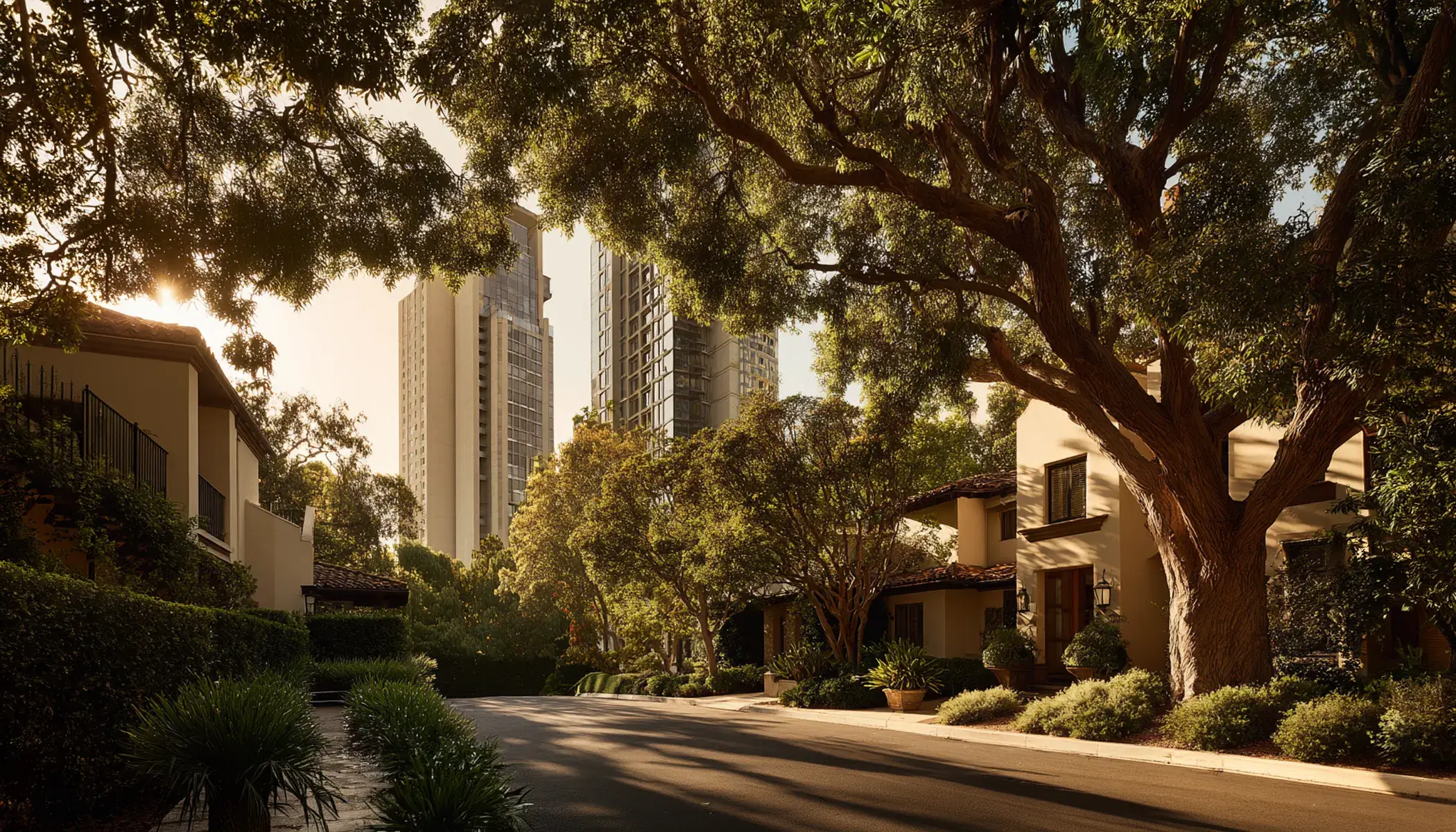
Little Holmby is the premier single-family home pocket in Westwood. It sits north of Wilshire and south of Sunset, with access points near Hilgard and Beverly Glen. The neighborhood is defined by tree-lined streets, larger lots, architectural significance, and proximity to Holmby Park. Many homes feature classic Spanish, Traditional, Tudor, and newer custom designs. The overall character is established and prestige-driven.
Typical pricing runs from $5 million to $20 million and above, with higher outliers for the most significant properties. This is the most sought-after and architecturally significant part of Westwood. The buyer profile reflects that: long-tenured residents, established families, executives, and buyers who want a legacy property that holds its position over decades. Little Holmby consistently ranks among the most desirable single-family neighborhoods in West Los Angeles.
Comstock Hills
Comstock Hills is a highly desirable single-family neighborhood just south of Little Holmby. Generally located between Wilshire and Santa Monica Boulevard with proximity toward Beverly Glen, it offers slightly smaller lots than Little Holmby but strong architectural variety and excellent access to Westwood Village. Typical pricing ranges from $3 million to $5 million and above.
Many buyers view Comstock Hills as offering a similar single-family lifestyle to Little Holmby while providing a lower entry point. The lot sizes are still meaningful, the architecture is varied and interesting, and the neighborhood draws professional families and move-up buyers who plan to stay long-term.
Wilshire Corridor
The Wilshire Corridor is one of Southern California’s most established luxury condominium markets. Running along Wilshire Boulevard between Westwood and Beverly Hills, the Corridor includes some of the most recognizable high-rise buildings on the Westside. Notable buildings include the Carlyle, the Remington, Wilshire House, Blair House, the Californian, the Wilshire Regent, the Dorchester, the Diplomat, the Longford, the Westford, Ten Five Sixty, the Comstock, and Beverly West.
Pricing spans a wide range from roughly $700,000 to $10 million and above depending on building, floor, and unit size. The Corridor attracts buyers seeking concierge services, valet parking, 24-hour security, and lock-and-leave convenience with larger condominium floorplans. It is the natural fit for downsizers leaving single-family homes in Westwood, Beverly Hills, or Bel Air. It also draws international buyers, pied-a-terre buyers, and professionals prioritizing convenience and services over owning land.
My Wilshire Corridor Millionaires’ Mile overview covers the building-by-building view, and the Carlyle Residences profile shows the building-level analysis I run on every Corridor purchase.
Westwood Village
Westwood Village is the commercial and cultural center of the neighborhood, directly adjacent to UCLA. It is the most walkable part of Westwood, with restaurants, coffee shops, grocery stores, entertainment, and campus all within easy reach. The residential inventory here is higher density and condo-heavy.
The buyer profile skews toward UCLA-affiliated professionals, first-time buyers, investors, and buyers prioritizing walkability. For buyers who want urban-style walkability inside Westwood, the Village is the closest thing to that experience. Daily life can be done on foot, which is rare in this part of Los Angeles.
Westwood South of Wilshire
The area south of Wilshire, extending toward Olympic, offers a mix of single-family homes, townhomes, condominiums, and smaller multifamily buildings. Price points are more accessible than the neighborhoods north of Wilshire, typically ranging from $2 million to $5 million and above.
This is often the entry point for buyers who want a single-family home in the 90024 zip code without the premium that Little Holmby and Comstock Hills command. The trade-offs are smaller lots and a less uniform streetscape. The benefits are real ownership inside Westwood at a workable price. Many buyers find this area offers a compelling balance between value, location, and long-term appreciation potential.
Key Decision Factors Across Westwood Sub-Neighborhoods
Price Per Square Foot Can Be Misleading
Condos and smaller single-family homes sometimes trade at similar per-square-foot numbers despite being very different products. Little Holmby and Comstock Hills command a clear premium driven by land value and location prestige. Price per square foot is a useful sanity check but not a useful decision tool. The actual question is what kind of property and life you are buying into. For current pricing data by area, my overview of what it costs to buy a home in Westwood covers the market by segment.
Walkability Varies Significantly
Westwood Village is the most walkable sub-area by a wide margin. The Wilshire Corridor varies by building. Some sit within walking distance of everyday services while others are more car-dependent. Little Holmby and Comstock Hills are primarily car-oriented neighborhoods where you drive for most errands and dining.
Demographics and Lifestyle Differ
Little Holmby draws established, long-term ownership. Comstock Hills attracts professional families and long-term residents. The Wilshire Corridor is mixed: downsizers, international buyers, and working professionals all show up there. Westwood Village is UCLA-driven. South of Wilshire has the most diverse mix of buyer types and backgrounds.
Transit and the Metro D Line Are Changing the Picture
The Metro D Line extension introduces stations at Wilshire/Westwood and Westwood/VA Hospital. This is already increasing demand for nearby condos and strengthening rental appeal near the planned stations. The greatest direct impact will be felt along the Wilshire Corridor and in South of Wilshire, where transit-adjacent properties are positioned for long-term demand growth. Buyers thinking 5 to 10 years out should factor this in.
Schools Are Mostly Uniform
Across most of 90024, public school boundaries are the same. Buyers typically focus more on proximity to a given school rather than school quality differences across sub-areas. The school question usually narrows to “which Westwood school is closest” rather than “which Westwood sub-neighborhood has the better schools.”
Which Part of Westwood Is Right for You?
There is no universally “best” part of Westwood. The right choice depends on budget, property type preference, walkability goals, lifestyle priorities, and long-term plans. Here is how the decision typically breaks down by buyer profile.
Young Families ($2M to $5M)
Young families in this range typically land in Comstock Hills or South of Wilshire. Comstock Hills offers family-sized lots, strong school access, and room to grow. South of Wilshire works at a lower entry point with smaller lots but the same zip code benefits.
Move-Up and Established Buyers ($4M and Above)
Move-up and established buyers at $4 million and above gravitate toward Little Holmby for its established prestige and larger lots. Comstock Hills serves as the strong alternative for buyers who want single-family living without the full Little Holmby premium. Both areas hold value well over long ownership periods.
Downsizers Leaving Larger Homes
Downsizers leaving large homes almost exclusively target the Wilshire Corridor. The full-service condominium lifestyle, proximity to the existing Westwood social network, and the financial benefits of Prop 19 tax portability make this the core luxury transaction pattern in the neighborhood. My downsizing playbook walks through the full transition.
Pied-a-Terre Buyers
Pied-a-terre buyers focus on the Wilshire Corridor, particularly east-end buildings closer to Beverly Hills. Lock-and-leave security, doorman service, and minimal maintenance are the deciding factors. These buyers want a property that runs itself when they are out of town for months at a stretch.
Professionals
Professionals, whether UCLA-affiliated or working on the Westside, tend to look at Westwood Village for walkability or South of Wilshire for long-term value and more space. The choice often comes down to whether walkable urban living or owning a small single-family home is the higher priority.
Investors
Investors consider Westwood Village for its liquidity and rental demand driven by UCLA, and South of Wilshire for long-term appreciation upside. Little Holmby and Comstock Hills are generally too expensive to make investment math work against the neighborhood’s rental ceiling.
How the Westwood Sub-Neighborhood Decision Actually Works in Practice
When someone says “I want to buy in Westwood,” the real work starts after that. We narrow based on property type, budget, lifestyle preferences, walkability needs, and long-term goals. From there, one or two sub-areas usually emerge as the obvious fit.
The biggest mistake buyers make is skipping this step. Looking across multiple sub-neighborhoods at once leads to confusion, poor comparisons, and decision fatigue. Touring six properties across four sub-areas when your life actually fits one sub-area wastes time and muddies your anchoring. The discipline is in narrowing first, then searching within the right area.
For the broader Westwood market context, my Westwood 90024 real estate overview covers the neighborhood at a higher level. If you are also thinking about an exit while you buy, my how to sell a house in Westwood guide covers that process.
Frequently Asked Questions About Westwood Sub-Neighborhoods
What is the most expensive Westwood sub-neighborhood?
Little Holmby consistently commands the highest prices in Westwood, followed by Comstock Hills. Some Wilshire Corridor penthouses can reach similar price points, but the property type is very different. You are comparing a condominium to a single-family estate, which is a different value conversation.
Do all Westwood sub-neighborhoods have the same schools?
Most of 90024 falls within the same public school boundaries. Buyers typically focus more on proximity to the school rather than differences in school quality across sub-areas. The school question usually narrows to walking distance and traffic patterns rather than school choice itself.
Is the Wilshire Corridor actually part of Westwood?
Yes. The Wilshire Corridor is a distinct sub-area within Westwood with its own buyer profile and pricing dynamics, but it sits inside the 90024 zip code and the Westwood neighborhood boundaries. It is part of Westwood in every practical sense.
What is the difference between Little Holmby and Holmby Hills?
Little Holmby is part of Westwood and sits north of Wilshire Boulevard, near UCLA and Holmby Park. Holmby Hills is a separate ultra-luxury residential neighborhood adjacent to Little Holmby and centered around larger estate-style properties near Holmby Park and the Los Angeles Country Club area. The names are similar, and the neighborhoods sit close to one another, but they are different markets with different price points, lot sizes, and buyer profiles.
Which Westwood sub-neighborhood is closest to UCLA?
Westwood Village is directly adjacent to the UCLA campus and is walkable in minutes. Parts of the Wilshire Corridor, particularly the western-end buildings, are also within walking distance for buyers who do not mind a 15 to 20 minute walk.
How does the Metro D Line extension impact Westwood sub-neighborhoods?
The Metro D Line extension increases accessibility and supports long-term demand, particularly for properties near the Wilshire/Westwood and Westwood/VA stations. The greatest near-term impact is on the Wilshire Corridor and South of Wilshire, where transit-adjacent properties have a structural tailwind.
Where do international buyers tend to land in Westwood?
International buyers concentrate heavily on the Wilshire Corridor, particularly for condo purchases. The full-service buildings, walkable proximity to UCLA, and established international communities make the Corridor the natural fit. Single-family buyers from outside the U.S. also show up in Little Holmby and Westwood Hills.
Which area is best for first-time buyers?
Many first-time buyers focus on condominiums in Westwood Village, the Wilshire Corridor, or residential areas south of Wilshire Boulevard. These areas offer the most accessible entry points into Westwood ownership with strong long-term appreciation potential.
Is Westwood a good long-term real estate investment?
Westwood has historically benefited from structural demand drivers that most Los Angeles neighborhoods cannot match. UCLA anchors consistent demand from faculty, staff, medical professionals, and international families. The central Westside location provides proximity to Beverly Hills, Century City, Brentwood, and Santa Monica. Limited land supply constrains new development, which supports pricing over time. These factors have made Westwood one of the more resilient residential markets on the Westside across multiple economic cycles.
Final Thoughts
Westwood has historically benefited from strong demand drivers including UCLA, its central Westside location, limited land supply, and proximity to Beverly Hills, Century City, Brentwood, and Santa Monica. Understanding which sub-neighborhood fits your specific situation is the first step toward making a smart purchase.
Whether you are evaluating estates in Little Holmby, condos on the Wilshire Corridor, or single-family homes south of Wilshire, I am happy to walk you through your options. You can reach me at (310) 299-7655 or pshilian@compass.com.
Disclaimer: This article is for informational purposes only and does not constitute real estate, financial, or investment advice. Pricing ranges and neighborhood character can change over time. Buyers should consult qualified professionals for legal, tax, and financial guidance specific to their purchase.
Narrowed it down?
Price per square foot swings meaningfully between these pockets for reasons that never show up in a listing description. Walk two or three before you commit to one.
Start a Westwood home search · Westwood compared with Brentwood

About the Author
Payman Shilian
Compass Real Estate Agent · Wilshire Corridor & Westwood Specialist · CA DRE 01913874
Payman Shilian has worked the Wilshire Corridor and Westwood markets for 14 years, closing 203 local transactions totaling over $210 million in career sales. Building-by-building expertise across The Carlyle, The Remington, The Wilshire, Beverly West, and the 40+ buildings of the Millionaires’ Mile. Persian and Farsi speaking. Doctorate of Pharmacy from UC San Diego. Designated Realtor for the City of Beverly Hills. Member, National Association of Realtors and California Association of Realtors. Philanthropic involvement with Children’s Hospital of Los Angeles.
Reach Payman directly: (310) 299-7655 · pshilian@compass.com · paymanshilian.com
Explore: Wilshire Corridor · Westwood 90024 · Downsizing Playbook · About Payman
